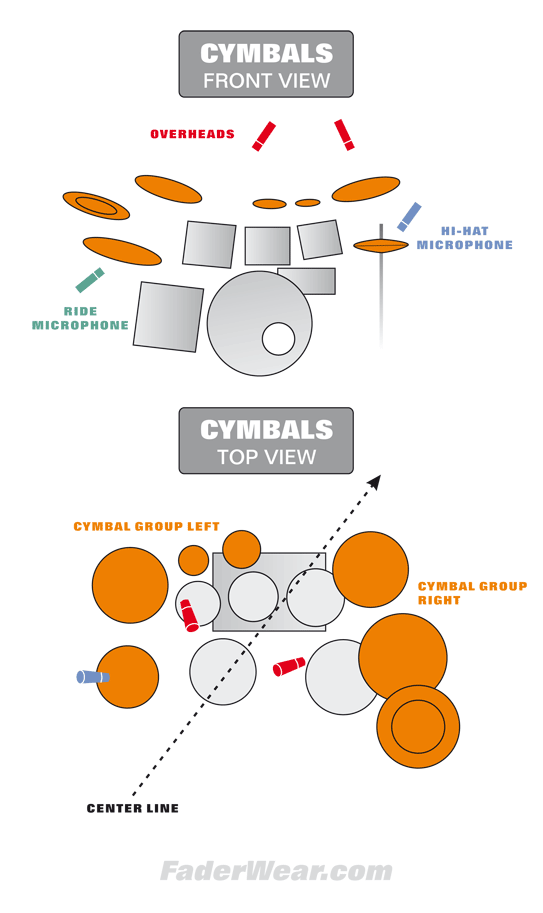
The traditional approach to overhead miking is to have a great "full kit image". This is where recording metal differs from other styles of music. If you want that modern in-your-face sound, you want separation. The snare drum in the overheads can be your worst enemy in the mix. It will always be there, but just try to minimize it.
A spaced pair of small-diaphragm condensers with a cardioid pattern works well in this application. Aim them at the cymbals at a small angle, away from the snare. Think of the cymbals as two groups: left and right. Try to place both microphones at equal distances from the snare. When you pan the overheads wide, the snare will be in the center. It will also minimize phase problems. You can use a microphone cable as a "tape measure." It would be great to have the kick in the center too, but most of the time this will be very hard to do. When the drummer is using two kick drums, it is impossible.
Listen to the cymbals and try to have them in a good balance. Don't set the microphones too high or you will end up getting too much room sound. Something like 1,5 to 2,5 feet (45-75 cm) from the cymbals is usually fine.
Use a separate microphone for the hi-hat and ride. Place the hi-hat microphone on top of the hats at a small angle and again try to avoid getting too much snare. A dynamic Shure SM7B sounds great here as do most large-diaphragm condensers (I'm not a big fan of small-diaphragm condensers on the hi-hat; they sound thin to me).
Mic the ride from underneath at a small angle, aiming at the bell. You will get great separation this way. Small- or large-diaphragm condensers work fine in this application.
Maximum Separation
Some engineers like to record all cymbals separately to achieve maximum separation. Miking the cymbals in pairs is usually enough. Just remember to draw a picture of the microphone setup! If will be very hard to figure it out later without any visual information.
For overheads you don't want the microphones to have a lot of high-end boost. It will make the mixing very hard. I prefer small-diaphragm condensers because they don't pick up the low end as much as large-diaphragm condensers. Overheads/cymbals are actually the only thing in the drumkit that you want to sound as natural as possible.
There are lots of good overhead microphones out there. From the cheaper ones my favorites are the Rode NT5 and SE Electronics sE3. The most common overhead microphones are the Shure SM81, Neumann KM184 and AKG C451B. Basically any good-quality small-diaphragm condenser will do.
When you get the sounds you want, hi-pass the overheads at around 400-600 Hz. It will make the following steps easier due to a cleaner sound.
3:1 Rule
To minimize phase problems, try to follow the 3:1 rule in microphone placement. In practice it means that if you place microphone X one inch away from the source, microphone Z should be at least three inches away from the microphone X. It creates a level difference of roughly 10 dB between the microphones. But if you get a good sound without following the rule, go for it! It's just a guideline.