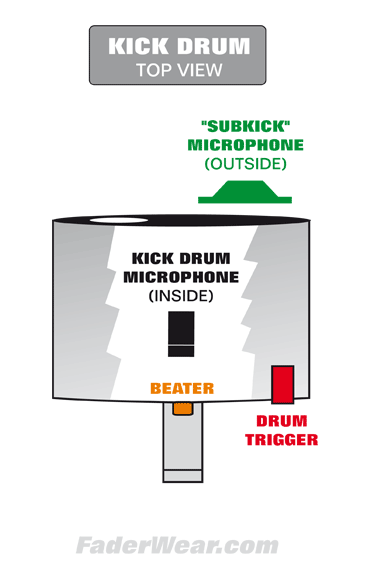
There are lots of different sounding kick drum microphones. For metal, the most common ones are the Shure Beta 52, AKG D112, Audix D6 and Sennheiser E602. My own favourite mic is a Beyerdynamic M88. It has a really tight sounding bottom and well-pronounced mids and highs. When the drummer is playing very fast, you want those mids to be there - at least in the recording.
Place the microphone inside the kick on-axis, about four inches (10 cm) away from the beater. The closer you go, the more attack you will get. If it sounds too clicky, you can try to change the angle a bit or move it further away from the beater.
I have not found much use for an outside mic, unless we are talking about a subkick type of thing. Some engineers like to build tunnels in front of the kick and place a large-diaphragm condenser microphone to catch the low end. To me, a "subkick"-type microphone works better. It's basically a woofer that is wired backwards. It will capture the frequencies below 100 Hz. You can buy the Yamaha Subkick or build your own. All you need is an 8" woofer and a stand. Search the web for "DIY subkick". The separation you get from these types of microphones is very good.
Separation
Most kick drum microphones have a tight polar pattern. It means that you won't get much bleed from snare or other the drums. If you do, you are probably using a cheap microphone or the drummer is not kicking hard enough. You can also reduce the snare bleed by aiming the microphone towards the bottom of the floor tom at a small angle.